Page Sentiment is a dashboard for reviewing the sentiment of comments on a Facebook Page. It fetches the latest comments on demand, runs them through a classical text-classification pipeline, and summarizes positive, neutral, and negative results in charts and tables. The backend is Flask/Python, the dashboard is Vue, and the saved scikit-learn Pipeline keeps text vectorization and classification together at prediction time.
Key features
Fetches the latest comments from a configured Facebook Page when the user requests an update; it does not rely on background workers, webhooks, or cron jobs.
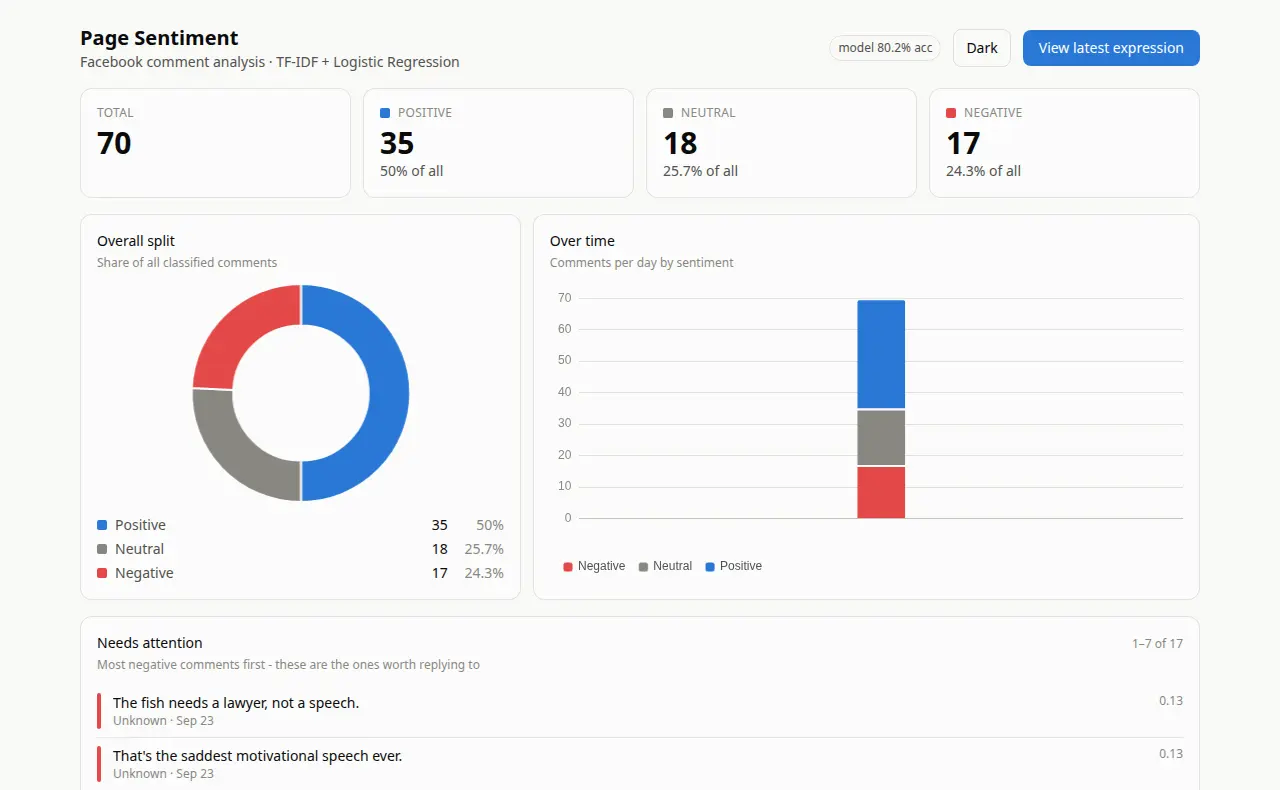
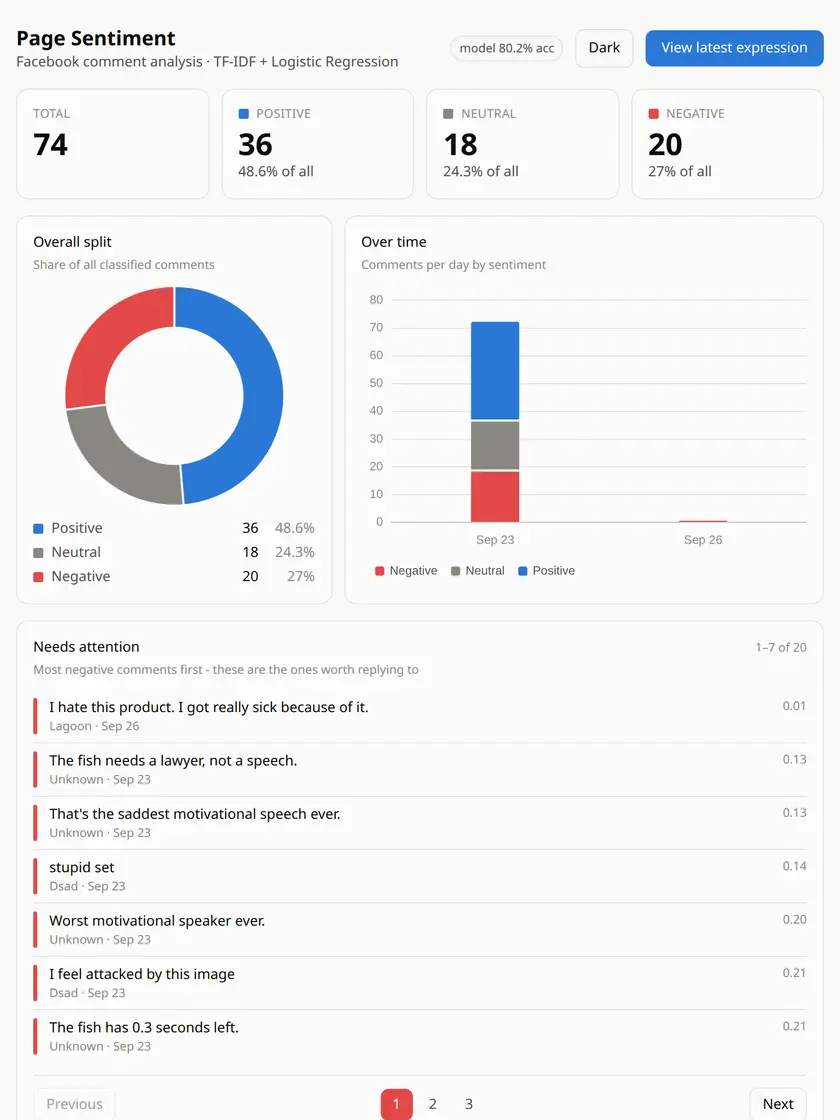
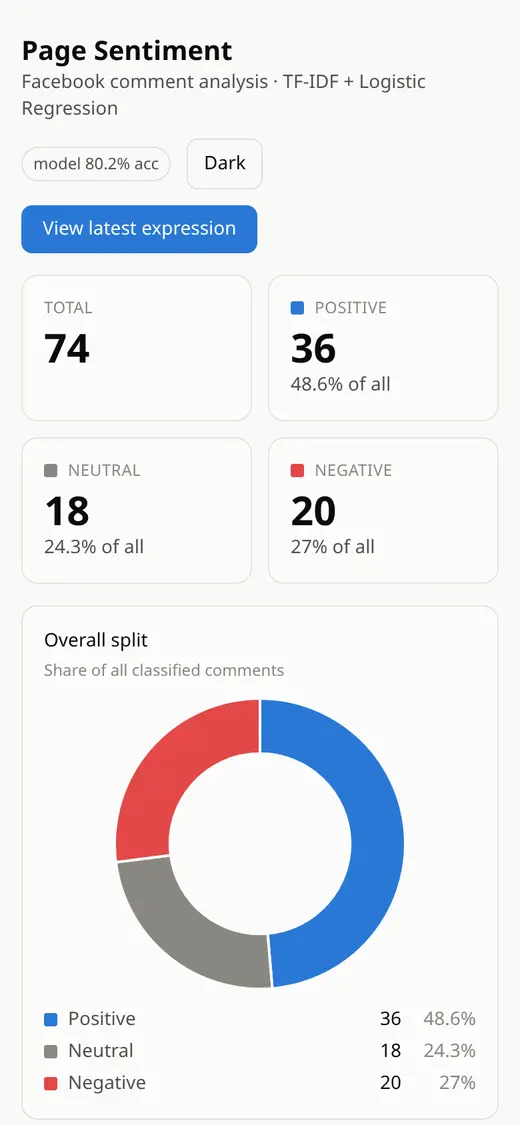
Summarizes classified comments with headline totals and positive, neutral, and negative proportions.
Shows sentiment distribution and comment activity over time with labeled dashboard charts.
Surfaces the most negative comments first in a needs-attention view to help prioritize replies.
Breaks sentiment down by post so page owners can compare comment patterns across posts.
Includes a try-the-model control for entering text and viewing the classifier's prediction.
Displays model insights, learned positive/negative terms, training configuration, and evaluation context.
Supports light and dark dashboard themes with a diverging positive/negative palette and neutral midpoint.
Engineering highlights
Trains on Sentiment140, a 1.6-million-tweet dataset; the documented default trains on a random 200,000-row sample for iteration speed.
Compares unigram and bigram TF-IDF feature configurations; the README reports 80.2% held-out test accuracy for the current 200k-sample model.
Saves the vectorizer and classifier together in a scikit-learn Pipeline so prediction uses the same vocabulary learned during training.
Uses a probability band from 0.40 to 0.60 to report neutral sentiment, since the source dataset itself is binary-labeled.
Separates data preparation, model training, prediction, Facebook API access, SQLite persistence, and Flask routes into backend modules.
The Vue/Vite frontend proxies API requests during development and can build into the Flask service for single-process deployment.
Challenges and approach
A binary training dataset cannot directly label neutral comments.
The prediction layer applies a documented 0.40–0.60 probability band as a calibration rule and returns neutral for predictions in that range.
Single-word features miss meaning that depends on negation, such as 'not happy'.
The README compares bigram TF-IDF configurations, which can retain phrases such as 'not bad' as combined features; stopword removal is adjusted so negation terms are not discarded.
English-only training data is not reliable for Bangla, Banglish, or sarcasm.
The project documents these limitations explicitly; non-English or empty cleaned input is treated as neutral with zero confidence rather than presented as a confident classification.